
Umbilical Cord Care at Home and What Normal Healing Looks Like

Umbilical cord care can feel stressful because the stump changes fast and it is hard to tell what is normal or what needs a call. It matters because cord infections are uncommon but young babies can get worse quickly when warning signs are missed.
In this guide you will get a day by day observation pattern, simple home steps to keep the area clean and dry, and clear thresholds for when to call your pediatrician versus seek urgent care.
General information only, not medical advice. Call your clinician or seek urgent care for emergencies, fever, poor feeding, breathing trouble, or any symptom that worries you even if it is not listed here.
Normal Healing Before the Cord Falls Off
Healthy cord separation is a drying process, not a wound you need to scrub open.
- The stump base may look a little sticky at first then it tightens and darkens as it mummifies.
- A faint odor can happen when the stump sits under a wet diaper edge, so the goal is airflow and dryness, not perfumed products.
According to the American Academy of Pediatrics guidance for families on umbilical cord care in newborns, dry cord care for many babies means you keep the area clean and dry without routine strong antiseptics unless your own clinician tells you otherwise for a specific reason (Source: AAP).
That matches what many US hospitals teach today, though your written discharge instructions should win if they differ.
Umbilical Cord Care Timeline
Use the table as a pattern guide not a medical chart. It walks what to actually look for across the first weeks window by window and pairs each stage with home steps and when to call your pediatrician. Babies vary by gestational age, cord thickness, and how often the stump gets damp from urine, spit up, or tight clothing.
- Gestational age and cord thickness can shift how fast the stump looks dry even when healing is normal.
- Urine spit up and tight clothing can keep the edge damp and change odor before you see obvious drainage.
If your baby is premature had a hospital stay for infection or had a special clamp device follow the unit discharge plan because timing can run longer than a simple home table suggests.
|
Window |
What the stump often looks like |
What you do at home |
Call the pediatrician if |
|---|---|---|---|
|
Birth–day 3 |
– Moist base, drying tip |
– Fold the diaper down so the cord stays dry |
– Redness spreads quickly |
|
Days 4–10 |
– Cord shrinks and feels firmer |
– Continue dry cord care |
– Foul smell with yellow or green drainage |
|
Days 10–21 |
– Very dry, narrow stump |
– Do not pull or twist |
– Any infection signs from the rows above |
|
After it falls off |
Small pink spot or mild crust at the belly button |
– Clean with water only if your clinician told you to |
– Raw lump that will not go away |
General information only, not medical advice.
Keep It Dry: Diapers and Clothing
Cord care is less about products and more about mechanics. Small layout choices reduce moisture and rubbing so the stump can finish its job.
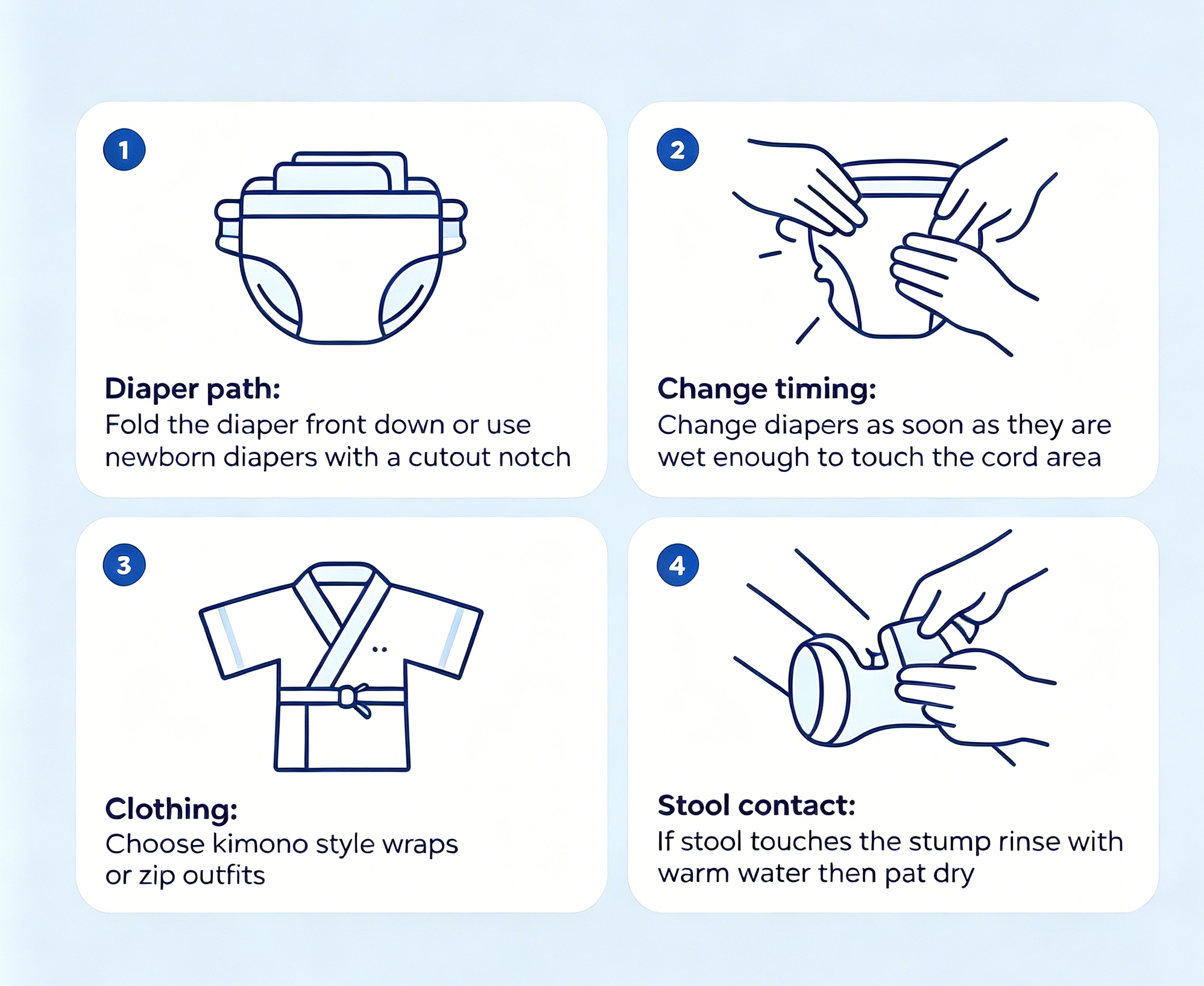
- Diaper path: Fold the diaper front down or use newborn diapers with a cutout notch if your brand offers it so urine does not wick upward into the stump.
- Change timing: Change diapers as soon as they are wet enough to touch the cord area because a damp stump macerates and smells worse faster.
- Clothing: Choose kimono style wraps or zip outfits that do not drag a seam across the stump and avoid tight waistbands and rough terry that scrapes the same spot during every curl and stretch.
- Stool contact: If stool touches the stump rinse with warm water that your clinician approves, then pat thoroughly dry with clean gauze or a soft cloth.
When Does the Cord Fall Off?
Many cords separate within the first two or three weeks and later separation can still be normal for some babies. When the stump finally detaches you might see a few pink spots on a diaper or onesie from the raw surface underneath.
- A few pink spots after separation can be normal while the raw surface dries.
- Steady dripping blood or a growing blood stain over hours needs prompt medical guidance even if the cord area otherwise looks calm.
- Let the stump fall off on its own even when it hangs by a thread because tugging raises bleeding risk and can leave a larger raw area than nature intended.
Infection Warning Signs
Think in three categories: appearance, odor, discharge, and how your baby acts. Infection is not common but the umbilical area can change quickly in a young infant so err on the side of a same day phone message when multiple warning signs stack.
The National Library of Medicine summarizes warning patterns for families in its MedlinePlus topic on umbilical cord care in newborns, including local signs at the stump and whole body symptoms that need urgent care. (Source: NIH) .
Watch at home with routine checks when the stump looks dry for its stage, odor improves after a diaper change and your baby feeds and acts like baseline. Pair quick cord checks with diaper changes, so you are not inventing hourly wakeups.
Call your pediatrician when you notice:
- Spreading redness beyond a narrow ring warmth or swelling at the base
- Yellow or green drainage or a bad smell that does not improve after a clean diaper change
- Pain when you touch the nearby skin or the baby cries with light contact at the base
- Seek urgent evaluation when you notice:
- Fever in a newborn poor feeding repeated vomiting or breathing difficulty
- Floppiness or a purple sick look even if the cord itself looks only mildly irritated
After the cord is gone, continue newborn belly button care the same way you protected the stump gentle cleansing only if needed and watch for a shiny pink bump that persists which your clinician can evaluate because some umbilical issues are simple office treatments.
General information only, not medical advice.
Common Cord Care Mistakes
Umbilical cord care at home rewards a boring routine: clean dry folded diapers loose clothing and a calm eye for infection signs. That steady approach is what makes the next mistakes easy to spot because they usually add moisture friction or anxiety driven checks that work against drying.
- Routine alcohol on the stump used to be common but many clinicians now avoid it for full term healthy babies because it can irritate tissue and is not always needed for prevention.
- Occlusion: Do not cover the stump with a tight bandage or plastic cap that traps moisture.
- Skip bath oils powders and adult skincare near the area unless your pediatrician names a specific product for a diagnosed issue.
- Sleep tradeoffs: Do not delay feeding or sleeping to obsessively inspect it every hour. Gentle checks with clean hands a few times a day, are enough.
When you still want a simple way to see whether the baby is truly unsettled as opposed to making normal newborn noise, a monitor can cut unnecessary nursery trips while you are healing especially overnight.
The eufy Baby Monitor E21 combines hybrid local and app viewing with cry aware alerts and 4K night vision so a quick check from bed can separate true fussing from normal newborn settling sounds before you commit to another nursery trip. Browse the eufy Baby Monitor collection once you know your room layout, range needs, and whether you prefer local video or app-based viewing.

Conclusion
Normal umbilical cord healing at home is usually a drying story more than a treatment project, so the core answer stays simple keep the stump clean and dry reduce urine and clothing friction and let separation happen on its own across a timeline that can vary baby by baby.
Your practical next step is to anchor quick checks to diaper changes and clothing swaps, then carry the same calm eye forward after the cord falls off while the belly button finishes smoothing out. When local warning signs worsen or stack with fever, poor feeding, breathing trouble, floppiness, or a purple sick look treat that as the signal to call the same day or seek emergency care rather than waiting to see if it passes.


