What Should a 5th Grader Know in Math? A Parent’s Guide
5th grade math surprises parents. The homework suddenly has fractions with different denominators, decimals three places long, and long division by two-digit numbers.
By the end of 5th grade, a child should be able to add and subtract fractions with unlike denominators (different bottom numbers), like 1/2 + 1/3. They should also be able to multiply fractions, work with decimals to the thousandths place, like 0.125, divide by two-digit numbers, and find the volume of a box.
These are the main 5th grade goals in the Common Core State Standards, which most US states use. Some states, like Virginia, use their own standards, but the big 5th grade topics are much the same.
Why Is 5th Grade Math So Important?
From 5th grade on, fractions, decimals and multi-digit operations become the base for middle school, high school and college math. Algebra, geometry and statistics all build on them. This is why it is important to find and fix math gaps early, in 5th grade or before.
If your child is not confident in math, consider personalized, one-on-one math tutoring. A dedicated 5th grade math tutor can find the exact skill your child is missing, explain it at your child’s pace, and give them space to ask the questions they may not ask in class. Each gap your child closes makes the next topic easier to learn.
What Does a 5th Grader Need to Know in Math?
A 5th grader needs to know around 6 important math concepts. However, the US Common Core State Standards name 3 of them as the most important for the year: fractions, decimals with multi-digit multiplication and division, and volume.
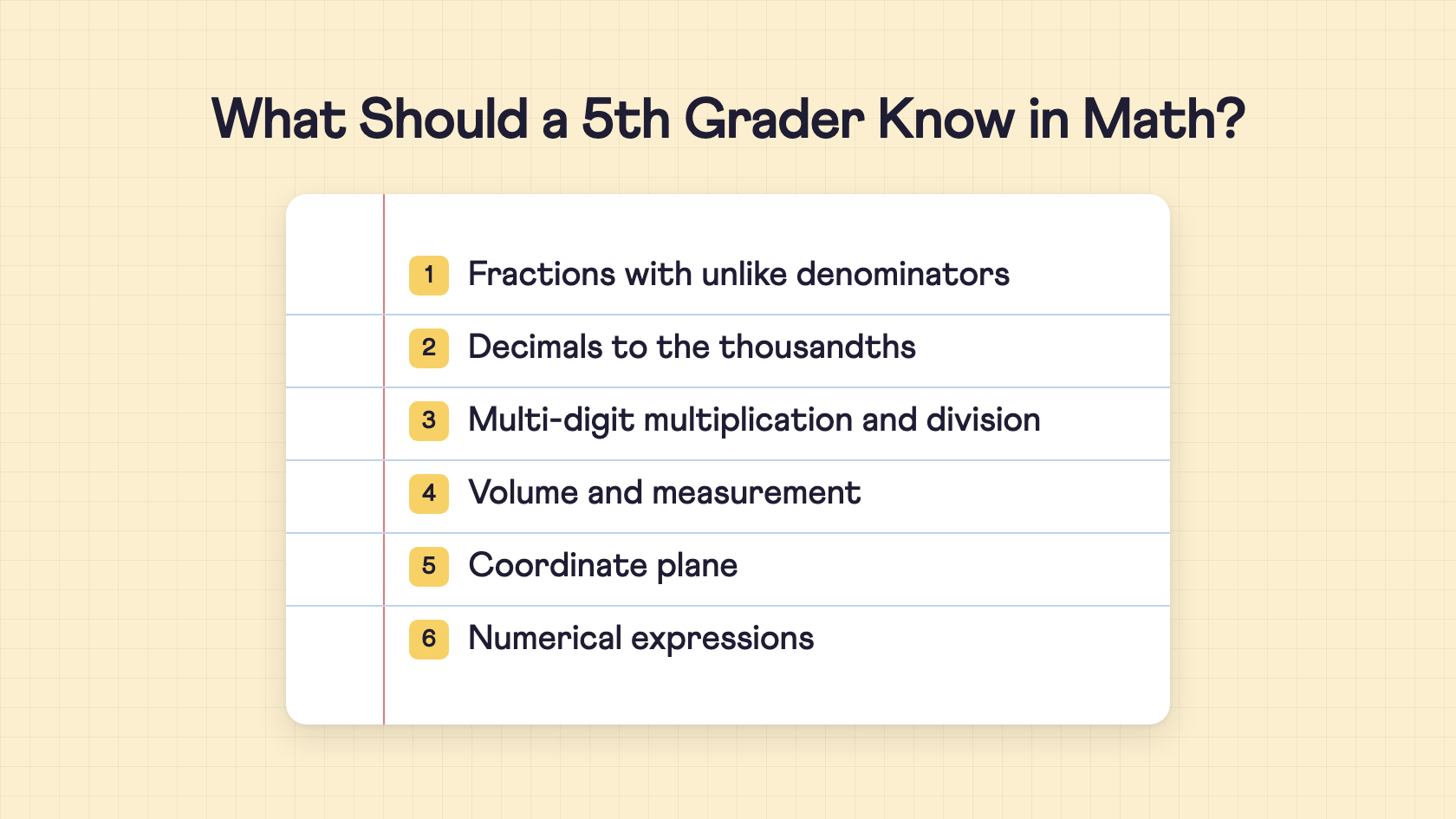
| Skill area | By the end of 5th grade, your child can |
|---|---|
| Fractions | Add and subtract fractions with unlike denominators; multiply fractions; divide with unit fractions, like 3 ÷ 1/4 |
| Decimals and place value | Read, compare and round decimals to the thousandths, like 0.125; add, subtract, multiply and divide decimals to the hundredths |
| Multiplication and division | Multiply multi-digit numbers like 246 × 37 fluently; divide numbers up to 4 digits by 2-digit numbers |
| Volume and measurement | Find the volume of a box; convert units, like feet to inches |
| Coordinate plane | Plot points on a coordinate grid |
| Numerical expressions | Evaluate expressions with parentheses, like 2 × (8 + 4) |
What Do 5th Graders Learn in Math, Topic by Topic?
5th graders learn to solve problems with fractions and decimals, not just whole numbers. They add, subtract and multiply fractions with unlike denominators, and divide with unit fractions in simple cases. They add, subtract, multiply and divide decimals to the hundredths.
They also multiply and divide multi-digit numbers, find the volume of boxes, and plot points on a coordinate plane. Then they use all of these skills to solve word problems with more than one step.
Before 5th grade starts, you can look through a detailed 5th grade math curriculum, based on the US Common Core State Standards. It shows every topic your child will learn during the year.
Fractions
In 4th grade, children add fractions that have the same denominator (bottom number), like 1/5 + 2/5. In 5th grade, the denominators are different, like 1/2 + 1/3. Your child also learns to multiply fractions and to divide with fractions in simple cases.
Your 5th grader should be able to:
- Add and subtract fractions with unlike denominators, like 1/2 + 1/3, and mixed numbers, like 2 1/2 + 1 1/4
- Find a fraction of a number, like 2/3 of 12
- Multiply two fractions, like 1/2 × 3/4
- Divide a whole number by a unit fraction (a fraction with 1 on top), like 3 ÷ 1/4
Decimals and Place Value
In 5th grade, place value goes past the decimal point. Each place is worth 10 times the place to its right. So 0.3 (three tenths) is 10 times 0.03 (three hundredths).
Your 5th grader should be able to:
- Read, write and compare decimals to the thousandths, like 0.405
- Round decimals to any place, like 3.47 to 3.5
- Add, subtract, multiply and divide decimals to the hundredths, like $3.75 × 4
Multiplication and Division
5th grade is the year Common Core expects children to multiply multi-digit numbers fluently, which means quickly and correctly, using the standard algorithm (the usual written method). Division gets bigger too: numbers up to 4 digits, divided by 2-digit numbers.
Your 5th grader should be able to:
- Multiply numbers like 246 × 37
- Divide numbers like 864 ÷ 24
- Explain what a remainder (the amount left over) means in a word problem
Volume and Measurement
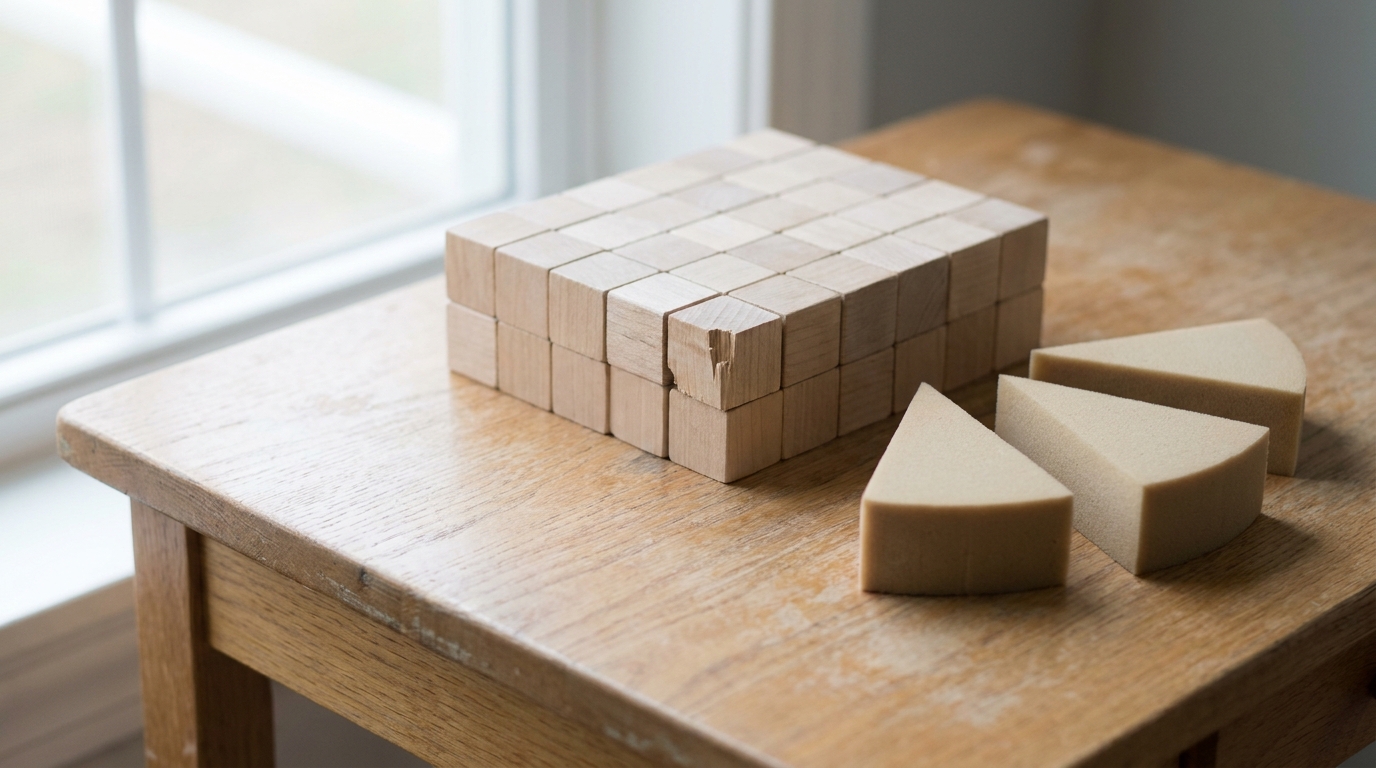
Volume is new in 5th grade. Volume means the space inside a 3D shape, like a box. Your child learns to measure it by counting unit cubes, which are cubes that measure 1 unit on each side.
Your 5th grader should be able to:
- Find the volume of a box by multiplying length × width × height
- Convert units within one system, like feet to inches or meters to centimeters
- Read a line plot (a number line with X marks above it) that uses fractions
Coordinate Plane and Numerical Expressions
5th graders start graphing. They plot points on a coordinate plane, a grid with numbered lines, which gets them ready for graphs in middle school. They also evaluate numerical expressions, where parentheses tell you which step to do first.
Your 5th grader should be able to:
- Plot a point like (3, 5): 3 steps right, then 5 steps up
- Evaluate an expression like 2 × (8 + 4)
- Spot a simple number pattern, like 3, 6, 9, 12, and say the rule (“add 3”)
What Does a Math Evaluation Show That a Report Card Doesn’t?
A math evaluation shows how your child thinks, not just how many answers they got right. A report card gives you a grade. A one-on-one evaluation shows you which skill is behind that grade.
After the evaluation, you get a report that scores your child in four areas:
| Area | What it means |
|---|---|
| Fluency | How quickly and correctly your child works with numbers and facts |
| Understanding | Whether your child knows why a method works |
| Application | Whether your child can use math in word problems and real life |
| Reasoning | How your child thinks through a new problem or puzzle |
The report also lists the two to four topics your child should work on first. You also get a learning plan built around the goals you share.
A single grade can hide a gap like this. The 5th graders in our evaluations did well when using math in real-life problems, but they were weaker on quick facts and on thinking through new problems. A report card that mixes everything into one grade would not show that difference.
Cuemath, a popular live 1:1 online math tutoring program offers this evaluation for free. Your child solves math problems one-on-one with a math specialist, and you keep the report and the learning plan, whether or not you sign up.